
PIFG ʻŌʻio (Bonefish) Tagging Project
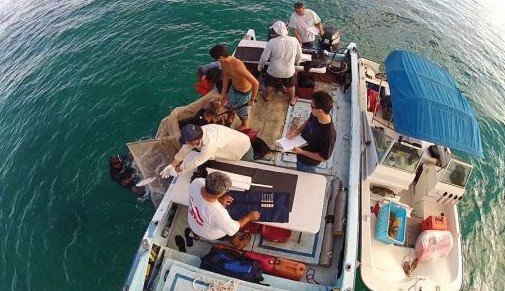
In this project, offshore populations of ʻōʻio (bonefish) were identified and captured for tagging using a traditional Hawaiian commercial fishing method known locally as “deep water bag net fishing”. Bag net fishing is highly selective and effective for targeting schooling fish species. The method enables fish to be held unharmed within a surrounding net, providing a means for unwanted fish to be released alive. This project combined this fishing method and proven high volume tagging methodologies adopted from previous tuna tagging projects to create a first-of-a-kind high volume tag and release research project for ʻōʻio (bonefish).
Previous ʻōʻio tagging projects have relied heavily on opportunistic recreational rod and reel fishing to deploy and recover tags. Recreational anglers primarily target ʻōʻio on nearshore shallow water flats and shoreline areas, presenting potential sampling bias towards only one of the two species found in Hawaii. Sharpjaw bonefish (A. virgata) are known to occupy deeper habitats, meaning some schools may be out of reach for many nearshore anglers. Imbalanced sampling of one species could provide an incomplete picture of Oʻahu’s ʻōʻio stock status. Using this bag net sampling method provides data on two species to create a more comprehensive biological picture of the oio stocks around Oahu.
Coordination and preparation of volunteers started with scouting for schools of ʻōʻio via fixed wing aircraft. Fishing operations were coordinated in real-time between the volunteer tagging crew and the spotter plane. Once the fish were successfully “bagged” in the surround net, volunteer taggers and gear were deployed to the tagging site via small vessels. A total of 3,000 oio were tagged during the project. 5 oio were tagged during a “trial run” tagging trip on February 18, 2011 and 2,995 oio were tagged during 4 volunteer tagging events on March 26, 2011, May 15, 2011, July 1, 2012, and July 22, 2012.

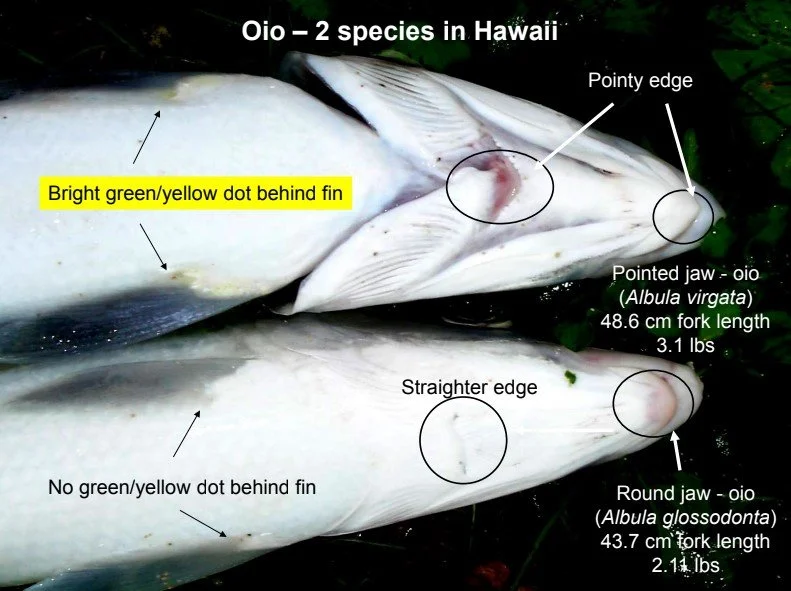
As of October 2016, there have been 86 oio tag recoveries reported. Short-term tag recoveries (recaptured within one year) indicate that large nearshore schools of ʻōʻio travel and freely intermix along the Waiʻanae coast of Oahu, Hawaii. The species composition of different sampling events showed that schools of ʻōʻio may be both species-specific or intermixed.
Longer term tag recoveries of over one year have shown travel well beyond the Waiʻanae area. The furthest recovery was a tagged oio that was recaptured off of Iroquois Point, Pearl Harbor, about 19 miles from where it was tagged. A few more ʻōʻio were recovered off of Kalaeloa, or Barbers Point. Data from longer term recaptures can provide very important information on the local ʻōʻio resource, identifying growth curves and potential movement patterns around the island.
Some growth rate information was generated from the short term recaptures, of which time at liberty ranged from 2 days to 169 days. Incremental growth ranged from zero to 2.8 inches. Future tag recoveries have the potential to yield information on potential seasonal and temporal variation in the growth rates of Hawaiʻi’s bonefish species.